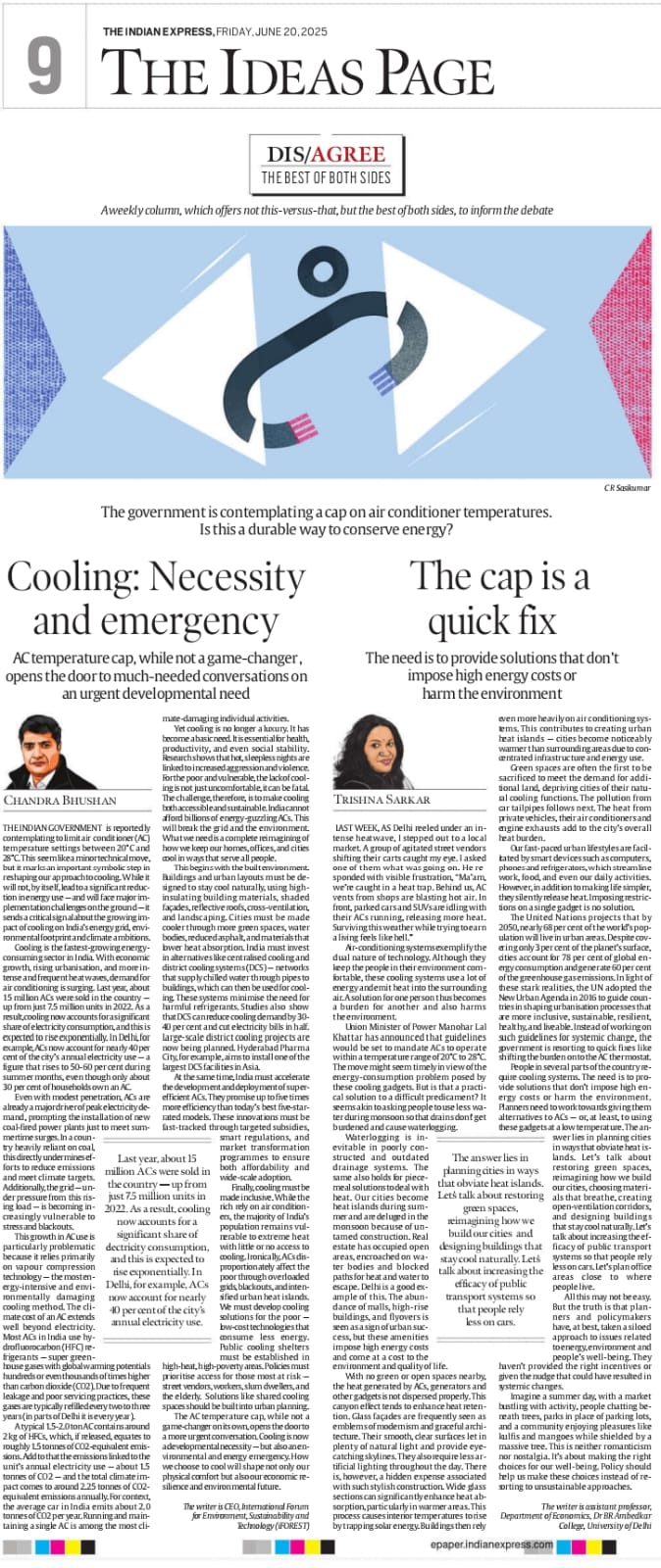


Why Rooftop Solar Power can be Assam’s Trump Card!

Today, Assam sources more than 70% of its electricity from coal and gas. Just 9% comes from renewable sources.

Assam is at a pivotal moment in its energy story. With electricity demand expected to double over the next decade, the State faces the dual challenge of meeting growing consumption while moving away from polluting fossil fuels. Today, Assam sources more than 70% of its electricity from coal and gas. Just 9% comes from renewable sour.
Assam is an energy-deficient State. Long transmission lines from distant coal plants lead to transmission losses and grid stress. How can Assam build a cleaner, more resilient power system that serves its people equitably?

The answer could be right above our heads.

Rooftop solar is emerging as the most practical, inclusive, and sustainable way forward for Assam. Unlike large solar parks or hydropower projects, it doesn’t need extra land or huge expenses, only unused rooftop space. It bypasses transmission bottlenecks, putting power directly in people’s hands. It fits well with Assam’s geography too, where land availability is limited.

The State has made some promising moves. Assam’s clean energy policy now targets 1,900 megawatts of rooftop solar by 2030, up from 300 megawatts earlier. Gujarat and Maharashtra have already installed about 5,300 MW and 3,400 MW, while Assam has installed just 75 MW.

Recognising this, the government offers a Rs 15,000 per kW subsidy, in addition to Central schemes like the PM Surya Ghar Muft Bijli Yojana (Rs 33,000 per kW). Rooftop solar is structured across government, commercial and industrial, and residential segments, with Assam Power Distribution Corporation Limited (APDCL) leading the charge.

According to a study by iFOREST, Assam has a total rooftop availability of 737.1 km², with 86% in rural areas. Nearly 95% is spread across residential and mixed-use buildings. The study shows that the State can generate more than 13,000 MW of solar electricity – enough to meet 100% of Assam’s annual power demand based on current consumption.

Urban centres such as Kamrup Metropolitan – especially Guwahati – offer the highest potential. Guwahati can host between 625 and 985 MW of rooftop solar. Areas such as Lokhra, Garchuk, Khanapara, Garbhanga, Sarusajai, Borsajai, Sawkuchi and parts of Dakhingaon stand out. Basistha, Dispur and Kahilipara are not far behind. If fully tapped, these can reduce the city’s dependence on grid-supplied thermal power.

What makes rooftop solar special is how people-powered it is. Rooftop solar is affordable, scalable and democratic. Every family, school, shop, village and city can tap into it. This is energy that citizens can invest in to run their homes, schools, shops and societies. Once installed, it slashes electricity bills – sometimes nearly to zero – and improves reliability. A typical household in Assam can cut electricity bills by 50% to 90%, depending on weather, usage and system size. Solar also provides backup during power cuts and peak demand periods. Assam gets over 280 sunny days a year, making rooftop solar a dependable option.

It’s also zero-carbon. Rooftop solar is clean, local and community-driven. Scaling it can create thousands of green jobs. If Assam harnesses the full 13,000 MW potential, this could mean 1.8 lakh jobs, especially for local youth. Good policies can fail if systems are not responsive. Across India, people have faced hurdles – delays in approvals, complicated paperwork, late subsidy payments, and substandard installations. Assam must avoid these pitfalls.

So, what will it take to unlock Assam’s rooftop solar potential?

  • First, streamline processes. Approvals and subsidy applications should be fast, simple and transparent.
  • Second, unlock finance. Even after subsidies, upfront costs remain a barrier. Assam must partner with banks and rural financial institutions to offer low-interest solar loans.
  • Third, assure quality. Poor installations damage trust. A State-certified registry of installers, backed by training programmes, can ensure quality. Every district should have skilled technicians.
  • Fourth, show it works. Schools, shops, government buildings and housing societies should serve as demonstration sites. When people see solar working in their community, it builds trust.
  • Finally, match policy with action. Set clear timelines for approvals, payments and financing. Invest in local skills and quality checks.

Citizens also play a role. Ask your neighbour about their solar panel. Request quotes from vendors. A solar-powered shop sends a message: green, modern, future-ready.
Imagine every home in Sarusajai, Lokhra or Dispur powered by the sun. Rooftop solar is a symbol of empowerment. Assam must walk the talk on clean energy, roof by roof, family by family, village by village. Because this shift is ultimately a profound act for better air, reliable energy and green livelihoods.

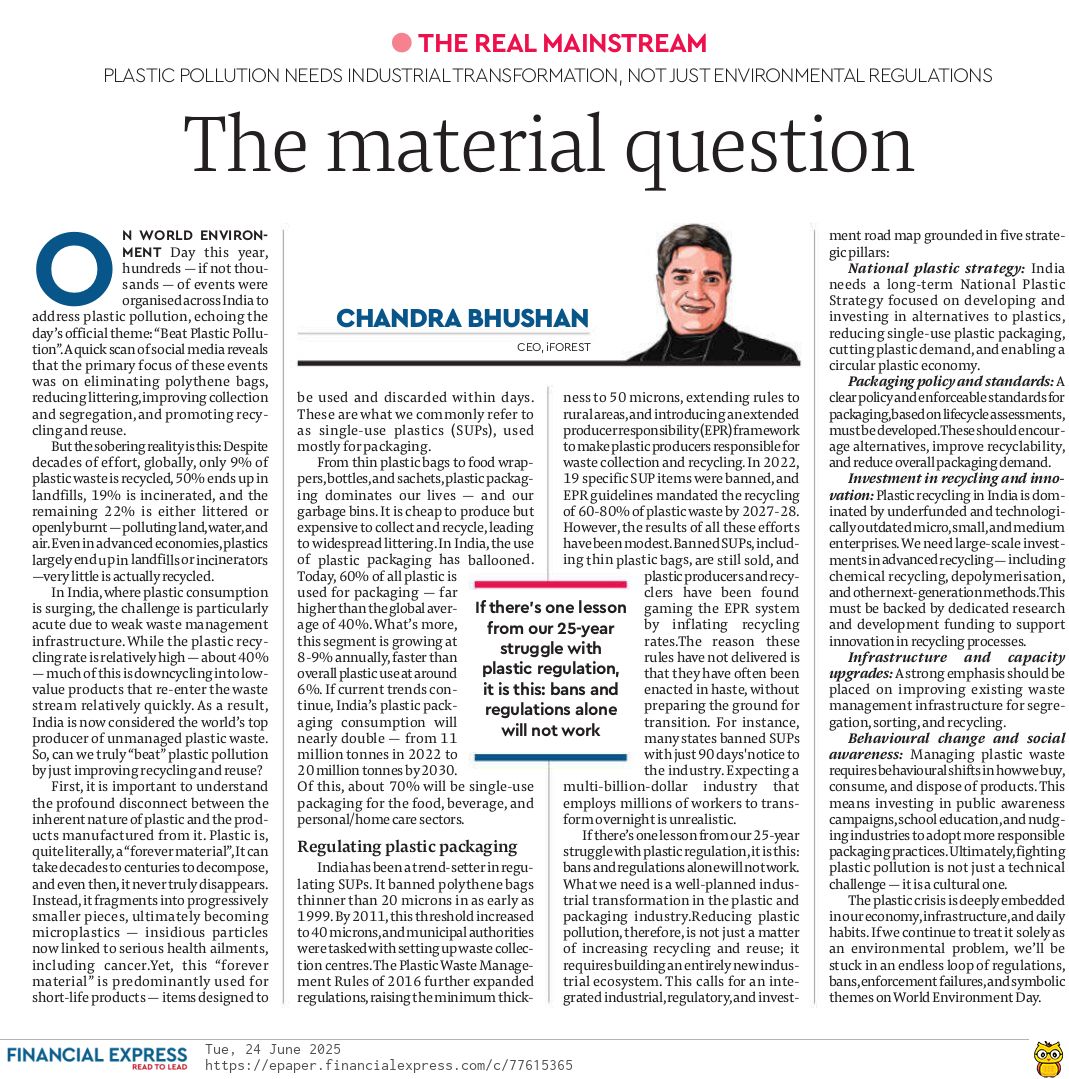
The material question

Plastic pollution needs industrial transformation, not just environmental regulations.

On World Environment Day this year, hundreds — if not thousands — of events were organised across India to address plastic pollution, echoing the day’s official theme: “Beat Plastic Pollution”. A quick scan of social media reveals that the primary focus of these events was on eliminating polythene bags, reducing littering, improving collection and segregation, and promoting recycling and reuse.

But the sobering reality is this: Despite decades of effort, globally, only 9% of plastic waste is recycled, 50% ends up in landfills, 19% is incinerated, and the remaining 22% is either littered or openly burnt — polluting land, water, and air. Even in advanced economies, plastics largely end up in landfills or incinerators —very little is actually recycled.

In India, where plastic consumption is surging, the challenge is particularly acute due to weak waste management infrastructure. While the plastic recycling rate is relatively high — about 40% — much of this is downcycling into low-value products that re-enter the waste stream relatively quickly. As a result, India is now considered the world’s top producer of unmanaged plastic waste. So, can we truly “beat” plastic pollution by just improving recycling and reuse?

First, it is important to understand the profound disconnect between the inherent nature of plastic and the products manufactured from it. Plastic is, quite literally, a “forever material”, It can take decades to centuries to decompose, and even then, it never truly disappears. Instead, it fragments into progressively smaller pieces, ultimately becoming microplastics — insidious particles now linked to serious health ailments, including cancer.Yet, this “forever material” is predominantly used for short-life products — items designed to be used and discarded within days. These are what we commonly refer to as single-use plastics (SUPs), used mostly for packaging.

From thin plastic bags to food wrappers, bottles, and sachets, plastic packaging dominates our lives — and our garbage bins. It is cheap to produce but expensive to collect and recycle, leading to widespread littering. In India, the use of plastic packaging has ballooned. Today, 60% of all plastic is used for packaging — far higher than the global average of 40%. What’s more, this segment is growing at 8-9% annually, faster than overall plastic use at around 6%. If current trends continue, India’s plastic packaging consumption will nearly double — from 11 million tonnes in 2022 to 20 million tonnes by 2030. Of this, about 70% will be single-use packaging for the food, beverage, and personal/home care sectors.

Regulating plastic packaging

India has been a trend-setter in regulating SUPs. It banned polythene bags thinner than 20 microns in as early as 1999. By 2011, this threshold increased to 40 microns, and municipal authorities were tasked with setting up waste collection centres. The Plastic Waste Management Rules of 2016 further expanded regulations, raising the minimum thickness to 50 microns, extending rules to rural areas, and introducing an extended producer responsibility (EPR) framework to make plastic producers responsible for waste collection and recycling. In 2022, 19 specific SUP items were banned, and EPR guidelines mandated the recycling of 60-80% of plastic waste by 2027-28. However, the results of all these efforts have been modest. Banned SUPs, including thin plastic bags, are still sold, and plastic producers and recyclers have been found gaming the EPR system by inflating recycling rates.The reason these rules have not delivered is that they have often been enacted in haste, without preparing the ground for transition. For instance, many states banned SUPs with just 90 days’ notice to the industry. Expecting a multi-billion-dollar industry that employs millions of workers to transform overnight is unrealistic.

If there’s one lesson from our 25-year struggle with plastic regulation, it is this: bans and regulations alone will not work. What we need is a well-planned industrial transformation in the plastic and packaging industry.Reducing plastic pollution, therefore, is not just a matter of increasing recycling and reuse; it requires building an entirely new industrial ecosystem. This calls for an integrated industrial, regulatory, and investment road map grounded in five strategic pillars

National plastic strategy: India needs a long-term National Plastic Strategy focused on developing and investing in alternatives to plastics, reducing single-use plastic packaging, cutting plastic demand, and enabling a circular plastic economy.

Packaging policy and standards: A clear policy and enforceable standards for packaging, based on lifecycle assessments, must be developed. These should encourage alternatives, improve recyclability, and reduce overall packaging demand.

Investment in recycling and innovation: Plastic recycling in India is dominated by underfunded and technologically outdated micro, small, and medium enterprises. We need large-scale investments in advanced recycling — including chemical recycling, depolymerisation, and other next-generation methods. This must be backed by dedicated research and development funding to support innovation in recycling processes.

Infrastructure and capacity upgrades: A strong emphasis should be placed on improving existing waste management infrastructure for segregation, sorting, and recycling.

Behavioural change and social awareness: Managing plastic waste requires behavioural shifts in how we buy, consume, and dispose of products. This means investing in public awareness campaigns, school education, and nudging industries to adopt more responsible packaging practices. Ultimately, fighting plastic pollution is not just a technical challenge — it is a cultural one.

The plastic crisis is deeply embedded in our economy, infrastructure, and daily habits. If we continue to treat it solely as an environmental problem, we’ll be stuck in an endless loop of regulations, bans, enforcement failures, and symbolic themes on World Environment Day.

Cooling: Necessity and Emergency

AC temperature cap, while not a game-changer, opens the door to much-needed conversations on an urgent developmental need

The Indian government is reportedly contemplating to limit air conditioner (AC) temperature settings between 20°C and 28°C. This seem like a minor technical move, but it marks an important symbolic step in reshaping our approach to cooling. While it will not, by itself, lead to a significant reduction in energy use — and will face major implementation challenges on the ground — it sends a critical signal about the growing impact of cooling on India’s energy grid, environmental footprint and climate ambitions.

Cooling is the fastest-growing energy-consuming sector in India. With economic growth, rising urbanisation, and more intense and frequent heat waves, demand for air conditioning is surging. Last year, about 15 million ACs were sold in the country — up from just 7.5 million units in 2022. As a result, cooling now accounts for a significant share of electricity consumption, and this is expected to rise exponentially. In Delhi, for example, ACs now account for nearly 40 per cent of the city’s annual electricity use — a figure that rises to 50-60 per cent during summer months, even though only about 30 per cent of households own an AC.

Even with modest penetration, ACs are already a major driver of peak electricity demand, prompting the installation of new coal-fired power plants just to meet summertime surges. In a country heavily reliant on coal, this directly undermines efforts to reduce emissions and meet climate targets. Additionally, the grid — under pressure from this rising load — is becoming increasingly vulnerable to stress and blackouts.

This growth in AC use is particularly problematic because it relies primarily on vapour compression technology — the most energy-intensive and environmentally damaging cooling method. The climate cost of an AC extends well beyond electricity. Most ACs in India use hydrofluorocarbon (HFC) refrigerants — super greenhouse gases with global warming potentials hundreds or even thousands of times higher than carbon dioxide (CO2). Due to frequent leakage and poor servicing practices, these gases are typically refilled every two to three years (in parts of Delhi it is every year).

A typical 1.5-2.0 ton AC contains around 2 kg of HFCs, which, if released, equates to roughly 1.5 tonnes of CO2-equivalent emissions. Add to that the emissions linked to the unit’s annual electricity use — about 1.5 tonnes of CO2 — and the total climate impact comes to around 2.25 tonnes of CO2-equivalent emissions annually. For context, the average car in India emits about 2.0 tonnes of CO2 per year. Running and maintaining a single AC is among the most climate-damaging individual activities.

Yet cooling is no longer a luxury. It has become a basic need. It is essential for health, productivity, and even social stability. Research shows that hot, sleepless nights are linked to increased aggression and violence. For the poor and vulnerable, the lack of cooling is not just uncomfortable, it can be fatal. The challenge, therefore, is to make cooling both accessible and sustainable. India cannot afford billions of energy-guzzling ACs. This will break the grid and the environment. What we need is a complete reimagining of how we keep our homes, offices, and cities cool in ways that serve all people.

This begins with the built environment. Buildings and urban layouts must be designed to stay cool naturally, using high-insulating building materials, shaded façades, reflective roofs, cross-ventilation, and landscaping. Cities must be made cooler through more green spaces, water bodies, reduced asphalt, and materials that lower heat absorption. India must invest in alternatives like centralised cooling and district cooling systems (DCS) — networks that supply chilled water through pipes to buildings, which can then be used for cooling. These systems minimise the need for harmful refrigerants. Studies also show that DCS can reduce cooling demand by 30-40 per cent and cut electricity bills in half. Large-scale district cooling projects are now being planned. Hyderabad Pharma City, for example, aims to install one of the largest DCS facilities in Asia.

At the same time, India must accelerate the development and deployment of super-efficient ACs. They promise up to five times more efficiency than today’s best five-star-rated models. These innovations must be fast-tracked through targeted subsidies, smart regulations, and market transformation programmes to ensure both affordability and wide-scale adoption.

Finally, cooling must be made inclusive. While the rich rely on air conditioners, the majority of India’s population remains vulnerable to extreme heat with little or no access to cooling. Ironically, ACs disproportionately affect the poor through overloaded grids, blackouts, and intensified urban heat islands. We must develop cooling solutions for the poor — low-cost technologies that consume less energy. Public cooling shelters must be established in high-heat, high-poverty areas. Policies must prioritise access for those most at risk — street vendors, workers, slum dwellers, and the elderly. Solutions like shared cooling spaces should be built into urban planning.

The AC temperature cap, while not a game-changer on its own, opens the door to a more urgent conversation. Cooling is now a developmental necessity — but also an environmental and energy emergency. How we choose to cool will shape not only our physical comfort but also our economic resilience and environmental future.


Social media & sharing icons powered by UltimatelySocial