
India’s ACs cool homes and are a hot problem

World Ozone Day is a good reminder of what refrigerants used in millions of air-conditioners do to environment. Hydrofluorocarbons heat up earth even more than CO2

The ozone hole is healing. The layer that shields us from the sun’s deadly ultraviolet rays was severely damaged by chemicals like chlorofluorocarbons (CFCs) and hydrochlorofluorocarbons (HCFCs), once widely used as refrigerants in air-conditioners and refrigerators. Thanks to the Montreal Protocol, these chemicals will be phased out globally by 2030. Scientists now predict that the ozone layer will fully recover by 2066, saving millions of lives from skin cancer.

Yet, as one crisis recedes, another is fast unfolding—this time caused by the new refrigerants that replaced CFCs and HCFCs. The coolants we use today—hydrofluorocarbons (HFCs)—are hundreds of times more potent than carbon dioxide (CO₂) in heating the climate. And in India, we are leaking them recklessly from our room air-conditioners (RACs).

A cooling boom

The sale of RACs has been growing at 15–20% annually since 2020. Urbanization, rising incomes, and intensifying heatwaves have turned ACs from a middle-class luxury into a household necessity. India currently has about 70 million RACs. Even with modest annual sales growth of 10%, this number will triple to 245 million by 2035.

But how responsibly are we using and maintaining our ACs? How conscious are we about energy efficiency? How frequently are we refilling refrigerants? And how aware are we of their harmful impacts?

To find answers, my colleagues at iFOREST recently conducted a first-of-its-kind national household survey covering more than 3,100 families from all income groups across seven major cities—Delhi, Mumbai, Kolkata, Chennai, Ahmedabad, Pune, and Jaipur. The results are both fascinating and deeply worrying.

Perception vs. reality

The survey busted some long-held myths. For instance, the perception that most AC-owning households have multiple RACs is incorrect. Nearly 87% of such households own just one AC; only 13% have more than two. This shows that ACs are no longer limited to the wealthy. A large share is now in middle- and lower-income households.

Another myth is that Indians operate their ACs at freezing lows. The survey shows that the most preferred temperature setting across cities is 22–26°C, not the ultra-low levels we often assume. There is therefore little need for the government to mandate thermostat settings.

Encouragingly, Indian consumers are conscious about energy efficiency. Nearly 98% of households own 3-star to 5-star rated appliances, with the 3-star category dominating.

But these positives are overshadowed by one stark reality: the way we service our ACs is damaging for both the climate and consumer pockets.

Servicing equals refrigerant refill

In India, refrigerant leakage and refilling have reached crisis proportions. About 80% of ACs older than five years require refilling annually. Even one-third of newer ACs—less than five years old—are refilled every year. In effect, around 40% of all ACs in India are refilled annually. Ideally, ACs should need a refill only once in five years. In India, it happens every two to three years.

This unnecessary refilling comes at a steep cost. In 2024 alone, India’s ACs consumed 32 million kg of refrigerant. At an average cost of ₹2,200 per refill, households spent about ₹7,000 crore ($0.8 billion). If business continues as usual, the refilling bill will quadruple to nearly ₹27,500 crore ($3.1 billion) by 2035.

The environmental cost is even higher. HFC-32, the most widely used refrigerant in India, is 675 times more potent than CO₂ in trapping heat. In 2024, refrigerant leakage from ACs emitted greenhouse gases (GHGs) equivalent to 52 million tonnes (MT) of CO₂. By 2035, this will rise to 84 MT.

When we add emissions from electricity consumption, the total GHG emissions of India’s ACs in 2024 reached 156 MT—about the same as emissions from all passenger cars in the country. Put simply: the annual GHG emissions from an AC that is refilled every two years is as much as a car. By 2035, the total emissions from ACs are projected to double to 329 MT, making them the single largest GHG-emitting household appliance in India.

Policy without teeth

While India does have policies on refrigerant management, these are half-measures without strong enforcement. The India Cooling Action Plan aims to reduce refrigerant demand by 25–30% by 2037–38, but lacks regulations to back it. Similarly, the amended E-Waste (Management) Rules, 2023, include provisions for environmentally sound disposal of refrigerants from end-of-life ACs at approved facilities, but these are being poorly enforced.

Therefore, currently there are no effective systems to prevent leaks during servicing, no monitoring of refrigerant refills, and no accountability for end-of-life disposal. Unlike plastics or electronic waste, refrigerants do not fall under any meaningful Extended Producer Responsibility (EPR) framework in India.

A solvable crisis

The refrigerant leakage crisis is urgent—but it is solvable. India must establish a comprehensive Lifecycle Refrigerant Management (LRM) regulation covering every stage—from refrigerant filling to servicing to disposal. AC manufacturers should be made responsible under an EPR regime to ensure recovery, recycling, and safe destruction of refrigerants. Such regulations are being implemented by many countries including Canada, Australia, the EU, China and Singapore.

If implemented effectively, LRM could prevent 500–650 MT of GHG emissions between 2025 and 2035—worth $25–33 billion in carbon credits at a moderate price of $50 per tonne. Consumers too would benefit, saving over $10 billion in unnecessary refill costs. This is a win-win solution: lower household expenses, reduced refrigerant wastage, and significant climate gains.

India showed leadership in the fight to protect the ozone layer by phasing out CFCs and HCFCs well before global deadlines. We can lead once again, this time in protecting the climate.

Beating the Heat

On September 2, 2025, Bhubaneswar became the first Indian city to release an Integrated Heat and Cooling Action Plan (IHCAP) to comprehensively tackle two growing crises—rising heat stress and the explosion in air conditioning demand.

Heat stress is not new to India. Over the past two decades, the country has experienced increasingly frequent and intense heatwaves that have claimed thousands of lives, reduced worker productivity, and strained health systems. But the crisis has changed. Cities are now caught in a vicious cycle of heat and cooling: higher temperatures and humidity drive-up air-conditioning use, which worsens the Urban Heat Island (UHI) effect and greenhouse gas emissions. This, in turn, makes cities even hotter—and more dependent on cooling.

It is precisely this cycle that Bhubaneswar’s IHCAP seeks to break. It is India’s first city-level plan that integrates urban planning, green buildings, sustainable cooling, and heat adaptation measures under one umbrella.

A City on the Frontline of Heat

Bhubaneswar has long been one of India’s most heat-affected cities. Over the last four decades, average temperatures and humidity levels have risen steadily across the year. Even more worrying is the rise in night-time temperatures, which robs people of relief and increases health risks. Today, heat stress stretches from February to October. As per the IMD’s “Feels Like” index, which uses temperature and humidity to measure heat stress, the city endured nearly 230 days of Yellow or Orange heat alerts in 2024.

Rapid urbanisation has further compounded heat stress. Between 2018 and 2024, Bhubaneswar’s built-up area grew by 23%, while vegetation declined by nearly 10% and water bodies by a staggering 75%. The result is a far more pronounced UHI effect, with the city now 2–5°C hotter than surrounding rural areas.

The impacts are already evident. Outdoor workers—from construction crews to street vendors—lose 20–30% of productivity and wages to heat stress. Overall, the city lost 8.6% of its annual income due to heat stress. At the same time, AC ownership has more than doubled in just two years, rising from 6% of households in 2021 to 15% in 2023. Cooling now accounts for one-third of the city’s electricity use—and nearly two-thirds in peak summer months.

Looking ahead, the situation could worsen dramatically. Under an intermediate climate warming scenario, a “normal hot day” in 2050 will feel like today’s extreme heat days. The city, therefore, will have to rely on cooling to survive. Under a Business-as-Usual (BAU) scenario, therefore, electricity demand from cooling could rise 7.6 times by 2050 compared to current levels.

What the IHCAP Offers

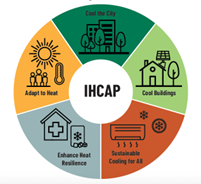
Against this backdrop, Bhubaneswar’s IHCAP lays out a comprehensive five-pillar strategy:

  • Cool the City: Expand greenery, revive water bodies, promote cool roofs, and redesign streets to reduce UHI.
  • Cool Buildings: Implement energy conservation building codes and promote climate-responsive designs to reduce heat absorption and enhance indoor comfort.
  • Sustainable Cooling for All: Ensure access to affordable, efficient, and climate-friendly cooling solutions such as efficient fans and ACs, district cooling systems, and white roofs for low-income homes.
  • Enhance Heat Resilience: Strengthen electricity, water, and health systems; build cooling shelters and provide cool bus stops and public water kiosks.
  • Adapt to Heat: Update heat alert thresholds to account for humidity and night-time temperatures, provide insurance for vulnerable workers, and expand awareness campaigns.

If implemented effectively, these interventions could reduce surface temperatures by 0.5–9.4°C, depending on the type of measure, and cut the city’s cooling-related electricity demand by 44–67% compared to the BAU scenario.

Beyond Bhubaneswar

The IHCAP connects two national policies that have so far worked in silos. The India Cooling Action Plan (ICAP) of the environment ministry that promotes sustainable cooling, and the Heat Action Plan (HAP) of the National Disaster Management Authority (NDMA), which focus primarily on early warning and heat adaptation. By unifying them, the IHCAP offers a comprehensive framework to address heat stress that other cities can adapt and adopt.

Scaling this framework, however, will require significant policy reforms. NDMA’s HAP guidelines must be updated to include heat mitigation and sustainable cooling measures. City master plans and building codes will also need revision. For example, the Energy Conservation and Sustainable Building Code, 2024 for commercial and institutional buildings and the Eco-Niwas Samhita 2024 for residential buildings cover only a fraction of upcoming construction. In Bhubaneswar, just 25% of commercial and institutional buildings and a mere 1.5% of residential construction fall under these codes. Likewise, master plans do not consider UHI, heat mitigation strategies or the need for heat-resilient infrastructure.

By mid-century, India will be home to 600–700 million urban residents, most of them in heat-stressed cities. Without integrated action, we risk a future where outdoor work becomes unsafe for millions, inequality deepens, and cities completely rely on cooling appliances to survive.

Bhubaneswar’s IHCAP, however, shows that cities can avoid this dystopian future and break the vicious cycle of heat and cooling through scientific modelling, innovative planning, and forward-looking policy.

Note: Bhubaneshwar’s IHCAP is developed by iFOREST in collaboration with the Singapore-ETH Centre, which is running the Cooling Singapore program.

Our Ruhr Valley Needs Reinvention

Spanning the coal-rich districts of Jharkhand and West Bengal, Damodar Valley (DV)-India’s ‘Ruhr Valley’-has powered the country’s growth since Independence. Coal from Jharia and Raniganj has fuelled India’s rise while steel plants of Durgapur and Bokaro, and fertiliser factories of Sindri became ‘temples of modern India’.

Today, the region stands as a stark paradox: rich in coal and industrial infrastructure, yet choking on resources that once made it prosperous. The air is thick with pollution, rivers flow contaminated and the economic model that once promised eternal employment is now creating a landscape of uncertainty. The imperative is clear: DV must urgently transition from a coal-based past, or risk terminal decline. Evidence of the coming decline is everywhere:

► In Dhanbad, India’s ‘coal capital’, nearly half the mines are abandoned or non-operational. By 2030, 80% of its mines will cease operations due to exhausted reserves or unprofitability. This story echoes across the Valley. Coal production in West Bengal’s Raniganj has plateaued at about 40-50 MT per year. Once the country’s largest coal producer, the Damodar basin has now fallen to third place, overtaken by coalfields in Odisha and Chhattisgarh.

► Downstream industries are faring no better. Jharkhand, sitting on mountains of coal, is ironically, a net importer of electricity. Ageing thermal power plants at Patratu, Bokaro, Bandel and Kolaghat have shut down. Overall, less than 5% of India’s thermal power capacity remains here. Even Damodar Valley Corporation (DVC)’s multi-purpose dams, designed for flood control, irrigation and hydropower, are silting up. Their power generation is minimal, and their flood-control capabilities are increasingly compromised.

But this is not just an economic crisis. It’s a human one. Over 2 lakh workers face the spectre of job losses. The region’s workforce participation rate is 30%. Without a viable alternative, the region is staring at a socioeconomic vacuum of immense proportions.

Yet, within this crisis lies an unprecedented opportunity. The same assets that defined the valley’s industrial age can be repurposed to build its green future. An August 2025 iFOREST Assessment, ‘Transforming India’s Coal Capital’, reveals that Dhanbad, Bokaro and Ramgarh (DBR)—the core of the valley—have the potential to become a major green industrial corridor.

The region has over 1 lakh ha of barren and mining-ravaged land, a potential site for solar farms capable of generating up to 10 GW of clean power by 2030. Reservoirs at Maithon, Panchet, and Tenughat can host floating solar projects and become the foundation for a green hydrogen industry.

With India pushing for hydrogen-based steelmaking and fertiliser production, DBR—with its existing steel and fertiliser plants and water infra—is uniquely positioned to become a hub for green hydrogen, green steel and green fertiliser. Also, repurposed coal mines into solar farms, industrial parks, or even as carbon sinks can drive local employment and economic diversification.

Infrastructure is already in place: robust connectivity via national highways and railways, and proximity to upcoming Amritsar-Kolkata Industrial Corridor. Most importantly, the region has a young, resilient workforce. To realise this potential, however, a good strategy is essential.

► Plan green GoI must partner with states to create a new blueprint for DV, transforming it from a traditional coal economy into a vanguard of green development. A dedicated Green Growth Plan for the DBR region should be the starting point. In addition, DVC must diversify into a green energy company.

► Just transition Workers and communities who built the coal economy must not be left behind. This requires investment in skilling, social protection and enterprise development. Jharkhand must prepare a ‘just transition policy’ to ensure that the move to a green economy is equitable and inclusive. Germany’s Ruhr Valley faced an identical crisis with the decline of coal. It chose a path of proactive transformation, investing in tech, education and culture. Its last coal mine closed in 2018. But today, former industrial sites are vibrant museums, universities and green spaces.

The valley now stands at the same crossroads. It has given its energy, environment and labour to build India. But it must now face the dual realities of depleting coal reserves and global shift toward clean energy. Ruhr teaches us that transformation cannot be left to chance. It requires foresight, planning and investment. If India acts decisively, Damodar Valley can avoid decline. Instead, it can lead the green transition in eastern India.

Breaking a vicious cycle

Scientific modelling, innovative planning, & forward-looking policy can help cities beat heat stress.

Bhubaneswar has become the first Indian city to launch an Integrated Heat and Cooling Action Plan (IHCAP).

On September 2, Bhubaneswar became the first Indian city to release an Integrated Heat and Cooling Action Plan (IHCAP) to comprehensively tackle two growing crises—rising heat stress and the explosion in air conditioning demand.

Heat stress is not new to India. Over the past two decades, the country has experienced increasingly frequent and intense heatwaves that have claimed thousands of lives, reduced worker productivity, and strained health systems. But the crisis has changed. Cities are now caught in a vicious cycle of heat and cooling—higher temperatures and humidity drive up air-conditioning use, which worsens the urban heat island (UHI) effect and greenhouse gas emissions. This, in turn, makes cities even hotter—and more dependent on cooling.

It is precisely this cycle that Bhubaneswar’s IHCAP seeks to break. It is India’s first city-level plan that integrates urban planning, green buildings, sustainable cooling, and heat adaptation measures under one umbrella.

A city on the frontline of heat

Bhubaneswar has long been one of India’s most heat-affected cities. Over the last four decades, average temperatures and humidity levels have risen steadily across the year. Even more worrying is the rise in night-time temperatures, which robs people of relief and increases health risks. Today, heat stress stretches from February to October. According to the India Meteorological Department’s (IMD) “feels like” index, which uses temperature and humidity to measure heat stress, the city endured nearly 230 days of yellow or orange heat alerts in 2024.

Rapid urbanisation has further compounded heat stress. Between 2018 and 2024, Bhubaneswar’s built-up area grew by 23%, while vegetation declined by nearly 10% and water bodies by a staggering 75%. The result is a far more pronounced UHI effect, with the city now 2 to 5°C hotter than surrounding rural areas.

The impacts are already evident. Outdoor workers—from construction crews to street vendors—lose 20-30% of productivity and wages to heat stress. Overall, the city lost 8.6% of its annual income due to heat stress. At the same time, AC ownership has more than doubled in just two years, rising from 6% of households in 2021 to 15% in 2023. Cooling now accounts for one-third of the city’s electricity use—and nearly two-thirds in the peak summer months.

Looking ahead, the situation could worsen dramatically. Under an intermediate climate warming scenario, a “normal hot day” in 2050 will feel like today’s extreme heat days. The city, therefore, will have to rely on cooling to survive. Under a business-as-usual (BAU) scenario, therefore, electricity demand from cooling could rise 7.6 times by 2050 compared to current levels.

What the IHCAP offers

Against this backdrop, Bhubaneswar’s IHCAP lays out a comprehensive five-pillar strategy:

Cool the city: Expand greenery, revive water bodies, promote cool roofs, and redesign streets to reduce UHI.

Cool buildings: Implement energy conservation building codes and promote climate-responsive designs to reduce heat absorption and enhance indoor comfort.

Sustainable cooling for all: Ensure access to affordable, efficient, and climate-friendly cooling solutions such as efficient fans and ACs, district cooling systems, and white roofs for low-income homes.

Enhance heat resilience: Strengthen electricity, water, and health systems; build cooling shelters and provide cool bus stops and public water kiosks.

Adapt to heat: Update heat alert thresholds to account for humidity and night-time temperatures, provide insurance to vulnerable workers, and expand awareness campaigns.

If implemented effectively, these interventions could reduce surface temperatures by 0.5-9.4°C, depending on the type of measure, and cut the city’s cooling-related electricity demand by 44-67% compared to the BAU scenario.

Beyond Bhubaneswar

The IHCAP connects two national policies that have so far worked in silos. The India Cooling Action Plan (ICAP) of the environment ministry promotes sustainable cooling and the Heat Action Plan (HAP) of the National Disaster Management Authority (NDMA) (focusses primarily on early warning and heat adaptation. By unifying them, the IHCAP offers a comprehensive framework to address heat stress that other cities can adapt and adopt.

Scaling this framework, however, will require significant policy reforms. The NDMA’s HAP guidelines must be updated to include heat mitigation and sustainable cooling measures. City master plans and building codes will also need revision. For example, the Energy Conservation and Sustainable Building Code, 2024, for commercial and institutional buildings and the Eco-Niwas Samhita 2024 for residential buildings cover only a fraction of upcoming construction. In Bhubaneswar, just 25% of commercial and institutional buildings and a mere 1.5% of residential construction fall under these codes. Likewise, master plans do not consider UHI, heat mitigation strategies, or the need for heat-resilient infrastructure.

By mid-century, India will be home to 600-700 million urban residents, most of them in heat-stressed cities. Without integrated action, we risk a future where outdoor work becomes unsafe for millions, inequality deepens, and cities completely rely on cooling appliances to survive.

Bhubaneswar’s IHCAP, however, shows that cities can avoid this dystopian future and break the vicious cycle of heat and cooling through scientific modelling, innovative planning, and forward-looking policy.

Social media & sharing icons powered by UltimatelySocial