
How to control air pollution from stubble burning

This is a straightforward article to discuss the real issues concerning stubble burning, including its contribution to pollution in Delhi-NCR, and why the solutions promoted by the government are not working.

Let’s start with the contribution of stubble burning to air pollution in Delhi-NCR. While we can bicker over the numbers, stubble burning is a short duration, highly polluting activity that significantly impacts air quality in October and November. The equation is simple: The 15-20 million tonnes of paddy stubble burnt in Punjab, Haryana, and western Uttar Pradesh, emit PM2.5 that is 4-5 times the annual PM2.5 emissions from all vehicles plying on Delhi roads. Let me repeat: PM2.5 emitted from stubble burning in just 60 days is 4-5 times what all Delhi vehicles emit in the entire year.

The intensity of emissions from stubble burning, therefore, is so high that even if a small fraction of these reaches Delhi, it would cause the city’s air quality to deteriorate significantly. This is precisely what happens during the stubble burning season. Wind coming from the northwest picks up pollutants from Punjab and Haryana and brings them to Delhi, worsening its already polluted air.

The next question is, why do farmers burn paddy stubble? First of all, not all farmers burn it; only about 25% of the paddy residues are burnt in Haryana, and this number goes up to 50-60% in Punjab. So, why do some farmers put their fields to flames while others don’t? There are three primary factors, apart from a few minor ones, that are driving this practice.

The most important factor is the technology used for harvesting. Farmers using Combine Harvester (called Combine) are most likely to burn the stubble, whereas those practising manual harvesting don’t. Combines cut the grainy part of the paddy plant (called spike) and leave about 30 cm of stem intact in the field. The farmer either has to manually cut the stem, use some machine, practice in-situ management, or burn it. Among these, burning is the easiest and most cost effective option.

The next factor is the use of the straw. Farmers who are unable to use or sell straw are burning it. In Punjab and Haryana, basmati paddy is mostly harvested manually because its straw is highly valued as animal fodder. The incidence of burning in basmati fields is, therefore, very low.

On the other hand, non-basmati straw is not used as animal fodder and hence is burnt. But there is a growing demand for non-basmati fodder in Rajasthan and Gujarat, and industries are also buying it for energy and other uses. Farmers who can sell their non-basmati straw do not practise stubble burning. Lastly, small farmers and tenant farmers are more likely to burn the stubble than big farmers, as they have fewer resources and risk appetite for using alternative technologies.

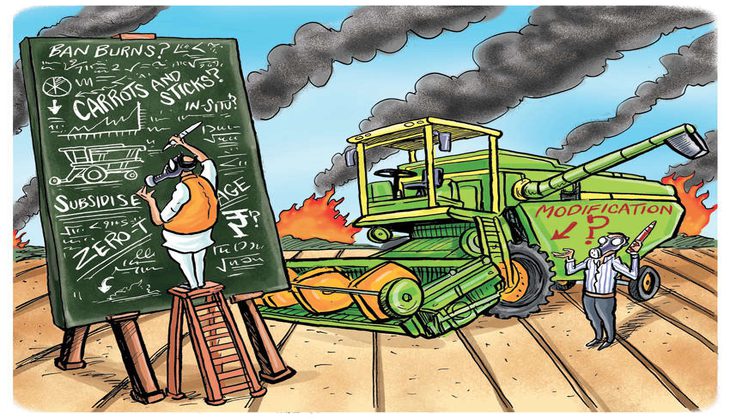
Now, let’s come to solutions promoted by the government. It has adopted a carrot and stick approach. On the one hand, it has banned burning and is imposing fines on farmers; on the other, it provides 50-80% capital subsidy to acquire farm machinery to adopt in-situ crop residue management. Unfortunately, neither is working.

It is vital to understand that the farm machinery the government is subsidising is not primarily designed to stop stubble burning. These machines are meant for zero tillage farming, in which stubble can be kept on the field and recycled in the soil. The zero tillage method has significant ecological benefits, including improvements in soil quality and lower water consumption; reduction in stubble burning is a co-benefit.

But zero tillage farming has two problems. First, it is an entirely new method of agriculture for Indian farmers. They have practised tillage agriculture for centuries, and therefore, moving them to zero tillage will not happen quickly. Second, it has a higher upfront cost. Despite subsidies, farmers incur an extra charge of about Rs 2,500 per acre to use these machines, which most can’t afford.

What, therefore, emerges from the above is that the use of Combines, weak market linkages for non-basmati stubbles and promotion of expensive technologies that require a long time for adoption, are sustaining the practice of stubble burning. What we need is a solution that is scientific, affordable, and culturally adaptable.

The easiest and affordable solution is to modify the Combine Harvester itself. We can redesign the Combine to cut the paddy straw from the plant’s base to remove the stem. The straw can either be sold or used as mulch in zero tillage agriculture. We can even incorporate a baling machine to the Combine to bale the straw, which can then be easily transported and sold.

The good news is that some newer versions of Combine already incorporate these features. I am not going to name companies, but I have seen foreign companies selling, in Haryana, precisely the kind of Combine I have explained above. The question is why Indian companies are not modifying their Combines and why the government is overlooking this simplest of solutions?

Ockham’s razor is a problem solving principle which states that the simplest solution is more likely to be correct than complex ones. This certainly is the case with stubble burning. By promoting complex solutions instead of a simpler one, we have botched up the stubble burning problem.
We have been barking up the wrong tree on air pollution

On its 46th foundation day, the Central Pollution Control Board (CPCB) released two reports that should force us to re-examine our approach towards controlling air pollution.

The first report is the ‘National Ambient Air Quality Status & Trends 2019’, which contains air quality data for 344 cities/ towns from 28 states and 6 UTs. This is the only report that gives a snapshot of the status of air pollution in the country.

The second is a report on the ‘Impact of the Lockdown on Ambient Air Quality’. This report compares data for 12 cities from different parts of the country, including Delhi and NCR towns, during the lockdown phases with the corresponding periods in 2019. The report also estimates the various sources on air pollution in Delhi by chemically analysing PM2.5 (particles less than 2.5 microns in size or fine particles) in different phases of lockdown. Furthermore, it measured PM2.5 concentrations using satellite to estimate the air quality improvement over the entire country.

Read in isolation, these two reports do not give us much new information than which is known or expected. For instance, it is known that air quality is a pan-India problem. Similarly, we all experienced cleaner air during lockdowns, and therefore, a dip in the ambient air quality levels was expected. But once we put these two reports together, a completely new picture emerges that puts a question mark on our approach so far in controlling air pollution and the way National Clean Air Programme (NCAP) is being implemented. Here are the major findings of these two reports:

India has predominantly a PM10 problem: Most cities are exceeding the National Ambient Air Quality Standards (NAAQS) for PM10 (particles less than 10 microns in size or coarse particles). About 78% of the cities exceeded PM10 standards compared to 36% for PM2.5, 9% for NO2 and none for SO2.

We are not winning the air pollution battle: The data for the last few years show that while the SO2 concentration has decreased and NO2 concentration has remained stable, the PM2.5 levels have increased and PM10 levels have remained very high and are fluctuating. So, the two problem parameters – PM2.5 and PM10 – are not showing any sign of abating. In fact, PM2.5 levels have increased significantly in the last three years.

The CPCB report also lays to rest the controversy about air quality improvements in Delhi. PM2.5 levels in Delhi have consistently increased in the last 3 years and were 144 micrograms per cubic meters (μg/m3) in 2019 – more than three times the standard.

The baseline pollution level in India is high: During the peak lockdown (March 25-April 19), ground based monitoring stations in 12 cities recorded average PM2.5 levels of 25-50 μg/m3 and PM10 levels of 50-110 μg/m3. The satellite recorded PM2.5 levels in different parts of the country as 29-76 μg/m3, with an all-India average of 59 μg/m3. These levels are double the WHO standards and almost the same as NAAQS.

So, when transportation and industries were down by 80%, coal power plants were operating at 40% capacity, and people were largely indoors, even in relatively less polluting months of March-April, the country was barely meeting NAAQS. This indicates that pollution from cooking fuel, agriculture and natural sources are sufficient to breach air quality norms in large parts of the country.

An interesting fact the report captures is that during the lockdown in Delhi, the ratio of PM2.5 to PM10 was higher than in 2019. This is contrary to the general understanding; one would have expected lower ratio during the lockdown because factories and vehicles were not operating. The only plausible reason seems to be that we have been underestimating the contribution of PM2.5 from cooking fuel and natural sources.

If we join the dots, what emerges is that controlling PM10 emissions is key to solving the air pollution crisis. This would mean reducing the burning of solid fuels like biomass and coal and controlling emissions from land and agriculture. But by mainly focussing on cities and vehicles, we have lost the plot on air pollution. I will discuss this in detail in my next column.

India needs a new EIA law

The Draft Environment Impact Assessment (EIA) notification 2020 has become a hot potato for the ministry of environment, forest & climate change (MoEF&CC). First, the Delhi high court overruled the ministry’s decision on the time limit for public comments and increased it till August 11. Then, in response to a formal complaint of the environment minister for spamming his email account, the cybercrime unit of the Delhi police invoked a terrorism-related law to shut down the website of young environmental campaigners, who were running an online campaign against the draft notification.

Though the police have now withdrawn the notice, the public uproar against the draft notification continues. Reportedly, lakhs of people have written to MoEF&CC to scrap the draft. So why is there such a hullabaloo around this subordinate legislation?

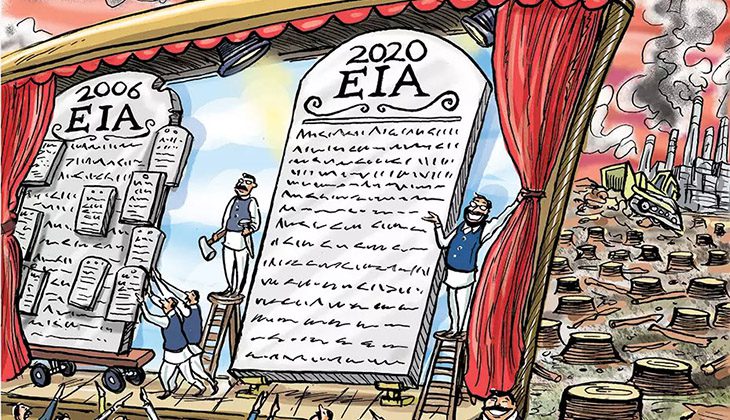
The draft EIA notification 2020 seeks to replace the existing law – the EIA notification 2006 – which grants Environment Clearance (EC) to projects. The major criticisms against the new draft are that it dilutes scope of public participation, legalises post-facto EC, removes the requirements of EIA study for several categories of projects, and weakens the provisions of reporting by companies. To understand the significance of these changes, let’s look at the 2006 law.

The EIA notification 2006 is possibly the most amended piece of environmental law. It has been amended 43 times, and at least 50 office memorandums (worth 350 pages) have been issued to tweak this law. Many of these changes have diluted the original version for some or other industry. The 2020 draft, in large part, brings together several of these revisions.

Therefore, effectively the 2020 version is a little worse than the existing one. So, while I appreciate the criticism of the proposed draft, keeping the 2006 version or even improving it is not going to solve the environmental problems in the country either. Let me explain why.

First, the approach of conducting EIA of individual projects is bad science. The environment is affected by the cumulative impacts of all activities, which project-specific EIAs fail to capture. Even if individual projects meet all benchmarks, their cumulative effects may still destroy the environment. This is evident in most mining and industrial areas of the country – from Singrauli to Korba and from Vapi to Patancheru.

Second, the EIA report, which forms the basis for EC decisions, is prepared by a consultant paid by the project proponent. This creates an apparent conflict of interest, and therefore most EIA reports are not worth the paper they are written on. I am yet to come across an EIA report that says that a project is likely to have significant ecological impacts.

Third, the process of the public hearing, which is mandated to take into account the concerns of the project-affected people, is a sham. Public hearing as practised in India is neither an informed consultation nor an informed consent. Most times, it is organised in the presence of police force, and physical violence is not uncommon.

Worse still, concerns of the community are most often dealt with in a cursory way by the expert appraisal committees (EACs). EACs typically ask companies to make some investments like building schools or providing drinking water to appease the community. MoEF&CC has even formalised this by calling these expenditures as ‘corporate environment responsibility’ (CER) and directing companies to earmark 0.125-2% of the capital investment on CER.

Finally, the environmental conditions imposed on the companies are rarely monitored by authorities. Monitoring is based on self-certified half-yearly reports submitted by companies; this has been reduced to yearly report in the 2020 draft.

The fact is that the current EIA and EC process in India is defunct. While it involves a lot of paperwork, there is little improvement on the ground. 99.9% of the projects are cleared, and non-compliance of the safeguards is rampant. The paperwork and transaction costs, on the other hand, gives legitimacy to industries to argue for watering down the process further.

It is, therefore, time that we demand a new EIA law based on sound science, and robust and transparent decision making processes to safeguard environment and community rights as well as to reduce investment risks of industries. This can be achieved by integrating three environmental concepts.

The first is the strategic environmental assessment (SEA). SEA will help to evaluate the ecological ramification of policies and plans and address concerns at the earliest stage of the decision making process. Many countries have adopted SEA to integrate environmental concerns in policy making.

The second is the regional planning approach. This involves conducting carrying capacity studies and developing regional plans based on them. This will allow us to take into account cumulative impacts and also provide information to project proponents to decide the location of the projects beforehand.

The third is project specific EIAs. In this, EIAs should be done for major projects and not for all. The focus here should be to improve environmental management plans and post-clearance monitoring. To ensure quality EIA reports, an environment information centre should be established to provide independent data to consultants and the EACs. In all the three processes, public participation should be ensured to improve assessment and scrutiny.

The EIA process is the most important piece of environmental law as it has the scope to decide the development trajectory of the country. But this powerful piece of legislation has never been discussed or legislated by the Parliament. Time to take the EIA discourse to the Parliament floor and develop a new law suitable for the 21st century.

Social media & sharing icons powered by UltimatelySocial