
The Real Mainstream: IPCC’s climate-speak is all Greek to the masses

The climate watcher has produced nothing for the general public, except for a press release and a set of headlines.

Scientists are good at science but bad at communicating it to the masses. This is precisely why the gap between the scientific understanding of the climate crisis and policy responses widens. The latest Intergovernmental Panel for Climate Change (IPCC) report is a classic example of ineffective communication. Published a few weeks back, it is considered the most comprehensive report on impacts, adaptation and vulnerability, but the presentation leaves much to desire.

The IPCC reports cater to a small set of people. For example, it is 3675 pages long (which very few outside the climate science community would ever read completely) with a 35 page summary. The summary, targeting policymakers, has been written in a complicated way and requires a person with high scientific knowledge to grasp its essence. Besides, IPCC has produced nothing for the general public except for a press release and a set of headlines.

While one can understand the trepidation of the scientific community for generalisation, it is precisely what is needed to get mass support for climate action. Therefore, it is high time that IPCC publishes and disseminates its findings in a way that most can understand and act on. I have attempted to convert the 35-page summary into ten key findings and put it in simple language. I hope that the IPCC would do better than this.

1. The climate crisis is far worse than previously predicted: The impacts on ecology, economy and human well-being are far worse than expected, and adapting to the crisis will be more difficult than anticipated.

2. It is destroying nature: Climate change has already caused substantial damage and increasingly irreversible losses to the biodiversity on land and oceans, including the extinction of hundreds of species. Approximately half of the species assessed globally have shifted polewards or to higher elevations to cope with increasing heat. Further temperature increases will irreversibly damage warm-water coral reefs, coastal wetlands, rainforests, and polar and mountain ecosystems and cause massive extinction of species dependent on these ecosystems.

3. Climate change is harming human health, peace, and wealth:  It has adversely affected physical and mental health. People have died worldwide due to extreme heat, flooding, and other extreme weather events. In addition, the incidence of climate-related food and water-borne and vector-borne diseases has increased. Cardiovascular and respiratory distress have also increased due to wildfire smoke, atmospheric dust, and aeroallergens.

Climate change is also making the poor poorer. For example, outdoor labour productivity, on which the poor depend for income, has reduced due to higher temperatures. Similarly, economic damages from climate change are prominent in agriculture, forestry, fishery, energy, and tourism, which provides the most employment.

Lastly, it is worsening humanitarian crises by driving displacement in all regions. Besides, evidence is emerging that global warming might be contributing to conflicts by creating a scarcity of water and fertile land.

4. India will be affected the worst:  Not every region will get equally impacted. Countries with poverty, governance challenges, limited access to essential services and resources, violent conflict, and high levels of climate-sensitive livelihoods such as smallholder farmers, pastoralists, and fishing communities, will be the worst affected. Approximately 3.3 to 3.6 billion people live in highly vulnerable regions to climate change; a significant proportion of them are in India.

5. Cities are hotspots: Rapidly growing cities of Asia and Africa that house large concentrations of poor people are especially vulnerable. Increasing temperature and poor development practices, like creating concrete jungles and encroachment of forests and water bodies, will increase heatwaves and flooding.

6. We are rapidly approaching the point of no-return: Climate change impacts and risks are becoming increasingly complex and challenging to manage. Multiple climate hazards will coincide, and multiple climatic and non-climatic risks will interact, creating unmanageable situations. Some losses are already irreversible, such as species extinction. Others are approaching the point of no return, such as the impacts on freshwater due to the retreat of glaciers.

7. Mitigation is the best adaptation: With temperatures rising, the inevitable losses will increase. For example, in the coastal ecosystems, the risk of biodiversity loss ranges from moderate and very high by 1.5°C warming but rises to high to very high by 3°C. So, keeping the temperature below 1.5°C by reducing emissions is the best way to save ourselves.

8. Good development practices mean good adaptation: Unsustainable land use, deforestation, biodiversity-loss, and pollution lower the capacities of ecosystems and societies to adapt to climate change. Eliminating unsustainable practices will significantly help adapt to the climate crisis. For instance, enhancing natural water retention in cities by restoring wetlands and rivers, creating no-build zones, etc., will lower flood risk. Similarly, on-farm water management like rainwater harvesting, soil moisture conservation, and efficient irrigation will improve productivity and reduce vulnerability.

9. Leaving nature alone will save us: Safeguarding biodiversity and ecosystems is fundamental to climate-resilient development. Globally, less than 15% of the land, 21% of the freshwater, and 8% of the ocean are protected areas. However, we will have to conserve approximately 30-50% of these areas to maintain the resilience of ecosystem services.

10. Unequivocal political commitment is a must: Implementing climate actions requires considerable upfront investments, while many benefits will only become visible later. To make such investments, unequivocal political commitment and farsighted planning are essential. In addition, new institutional frameworks, policies, and instruments will be required to set clear goals, define responsibilities and obligations, and coordinate amongst various actors.

Besides, governments alone cannot solve this problem; the role of businesses and civil society is equally critical. Raising public awareness and building social movements are essential for greater public and political commitment. Companies will have to play a greater role in reducing emissions and investing in adaptation. The report essentially says if the climate crisis is not a clear and present danger, nothing else is.
The truth about air pollution in Delhi

Contrary to the claims made by the Delhi government, air pollution in the city has deteriorated significantly since 2012.

There is an irony being played out in Delhi. While the national capital is reeling under one of its worst spells of air pollution, the Delhi government is bringing out a series of advertisements claiming that the pollution levels are down by 25%.

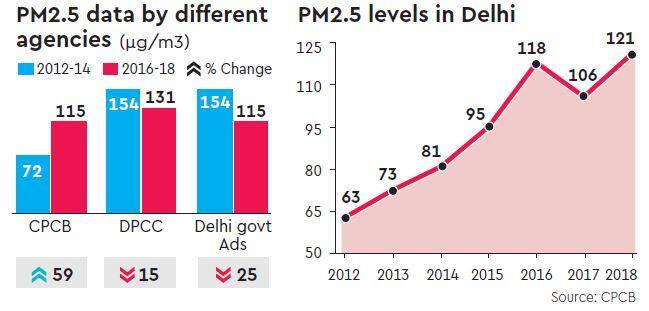
The advertisements mention that the levels of PM 2.5—particulate matter of size less than 2.5 microns—have reduced from 154 microgrammes per cubic meter (µg/m3) during 2012-2014 to 115 µg/m3 during 2016-2018. If this claim is valid, then we are on the right path, and we should continue with the current action plan to control air pollution. If it is not, then we should seriously change track and develop a new blueprint.

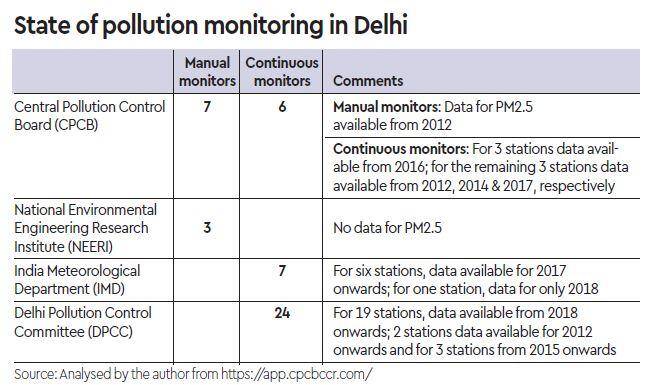
To understand the exact situation of pollution in the city, one has to understand the status of air pollution monitoring. Delhi has the largest number of air quality monitors in the country—47 monitoring stations, to be precise. Out of these, 10 are manual monitors, and 37 are continuous monitors. Four agencies own these monitors—the Central Pollution Control Board (CPCB) has 13 monitors, Delhi Pollution Control Committee (DPCC) has 24, India Meteorological Department (IMD) has 7 monitors, and the National Environmental Engineering Research Institute (NEERI) has 3.

Continuous monitors give pollution readings every 15 minutes, and these are used for calculating the Air Quality Index (AQI). CPCB has developed data validation criteria for these monitors. For example, continuous monitors must be operational for 16 hours in a day for estimating daily pollution levels. Similarly, they must be operational for 80% of the time in a year for determining the annual pollution levels.

In manual monitors, the monitoring is carried out for 24 hours, with a frequency of twice a week. There must be a minimum of 104 readings in a year for estimating annual pollution levels. In India, data from manual monitors are still used to make country-wide comparisons on the status of air pollution. The reason is simple: we have 573 manual stations in 240 cities/towns compared to just 202 continuous monitors in 112 cities/towns. Manual monitors, therefore, are sentinel monitors as they have comparable data for the longest time-frame.

As one can see in the accompanying graphic, continuous monitoring is a recent phenomenon in Delhi. Twenty continuous monitors were installed in 2018, and seven were introduced in 2017. We have data from only four monitors for 2012 onwards. But, there are significant data gaps from these four monitors. For instance, the Dilshad Garden monitoring station had correct data for only 32 days for 2013; the ITO station has data for less than 50% of the time for 2012, 2014, and 2016; and RK Puram has no data for 2013, and 2014. Most researchers have concluded that using data from the continuous monitors to estimate annual pollution levels for the years 2012 to 2016 is statistically wrong. Therefore, one has to rely on manual monitors to establish whether the pollution status has improved or deteriorated since 2012.

The data from manual monitors, published by CPCB, shows that the amount of PM 2.5 has almost doubled between 2012 and 2018—from 63 µg/m3 in 2012 to 121 µg/m3 in 2018. The average PM 2.5 level during 2012-2014 was 72 µg/m3, and during 2016-18, it was 115 µg/m3—an increase of 59%. So, air pollution levels in Delhi have increased significantly, and not reduced. From where, then, has the Delhi government put together data to show a reduction of 25%? Interestingly, there is another set of data put out by DPCC, which is less publicised. This DPCC data shows that the average level of PM 2.5 was 154 µg/m3 during 2012-14, which reduced to 131 µg/m3 during 2016-2018—a reduction of 15%. DPCC data, however, comes with a disclaimer. It clearly states that for the period 2012-2017, the data is based on four continuous monitors, and the 2018 information is based on 26 monitors. As explained above, the data from the four continuous monitors are incomplete. They cannot be the basis for estimating pollution levels during the 2012-2017 period. Even if we had complete data from the four continuous monitors, comparing data of four monitors with that from 26 monitors is highly spurious. It will not stand even the basic statistical scrutiny.

Nevertheless, let’s take the DPCC data with a pinch of salt, and put it together with the CPCB data. We can see, in the accompanying graphic, where the mistake has happened. The Delhi government has taken continuous monitoring data of DPCC for the period 2012-2014 and manual monitoring data of CPCB for the period 2016-2018 to claim that air pollution reduced by 25%. This is cherry-picking, and completely wrong. These types of analyses cannot be the basis for decision-making.

Let me end by saying that I support CM Arvind Kejriwal on stubble burning. He is absolutely right that the spike in pollution post-Diwali is because of stubble burning. One can smell biomass burning in the air, and we need to do something about this urgently. But, he is wrong to claim that his actions have led to a 25% reduction in pollution levels. Instead of putting out wrong information, it is important that his government goes back to the drawing board and develops a new blueprint for saving this historical city from Airpocalypse.

Single-use plastics: A roadmap to eliminate this menace

Even after enacting four major legislations in the last 20 years, we have not been able to eliminate even one single-use plastic product.

I am glad that the Union government didn’t announce any ban on single-use plastic products on the October 2, 2019. It is not that I don’t want these environmentally harmful products to be banned; it is just that I don’t think we have done the groundwork to implement a successful ban.

The history of plastic waste management in India is replete with hastiness; we have brought in regulations, but never prepared the market or the local government for the transition.

The first major regulation came 20 years back, in 1999. The Plastics Manufacture, Sale and Usage Rules, 1999, essentially tried to eliminate single-use polythene bags by specifying the size, and thickness of bags that could be sold in the market. It mandated that no carry-bags made of virgin, or recycled, plastic that are less than 8 x 12 inches in size, and less than 20 microns in thickness can be sold in the market.

The 1999 rules were amended, and the Recycled Plastics Manufacture and Usage (Amendment) Rules, 2003, was enacted to exempt export-oriented industry, and to improve enforcement. Alas, nothing much changed on the ground, and thin polythene bags continued to be sold widely in the market. During this period, no effort was made to promote an alternative to these carry-bags.

Then came the Plastic Waste (Management & Handling) Rules, 2011. In this, the minimum thickness of plastic carry-bags was increased to 40 microns, and municipal authorities were given the responsibility to set up systems for plastic waste management. Municipalities were also supposed to set up plastic waste collection centres, with financial support from the manufacturers, in line with the principle of Extended Producer’s Responsibility (EPR). But, EPR was vaguely defined, and never got implemented. The ban on less than 40-micron thickness carry-bags was also executed poorly, and municipalities were not capacitated to implement the rules.

The most comprehensive (and somewhat complicated) law came in 2016. The Plastic Waste Management Rules, 2016, came with a slew of provisions for everyone in the plastic supply chain. The rules:

  • Increase the minimum thickness of plastic carry-bags from 40 to 50 microns;
  • Expanded the jurisdiction of applicability from the municipal area to rural areas, and made gram panchayats responsible;
  • Defined a very complicated system of EPR for producers/brand owners that needed multiple registrations, and multiple payments;
  • Introduced plastic waste management fee through pre-registration of producers, importers and vendors. For example, the shopkeepers and street vendors willing to provide plastic carry-bags were asked to pay a hefty plastic waste management fee of a minimum of Rs. 48,000 per year.

Three years hence, hardly any of the above provisions have been implemented satisfactorily.

Then, in June 2018, on the occasion of World Environment Day, the prime minister vowed to phase-out single-use plastics by 2022. Before that, in March 2018, Maharashtra became the first state to implement a ban on single-use plastics. Telangana followed suit in June, and Himachal Pradesh and Uttar Pradesh in July 2018. Tamil Nadu, on January 1, 2019, became the fifth state, and Odisha, on October 2, 2019, the latest to implement a ban on single-use plastics. Today, at least 18 States and UTs have imposed a ban on plastic carry-bags, and some sort of ban on single-use plastic products. But, report after report indicates that after a spurt in enforcement at the beginning of the ban period, things are back to normal. Take the case of Uttar Pradesh, which has implemented the bans in phases.

On July 15, 2018, Uttar Pradesh banned single-use polythene bags, glasses, cups, and cutlery. From August 15, 2018, it imposed a blanket ban on the manufacture, stocking, sale, and transport of all disposable plastic and thermocol items. In the last phase, from October 2, 2018, disposal of all types of non-biodegradable polythene was banned to make Uttar Pradesh a plastic-free state. One year down the line, the bans have not been very successful in reducing single-use plastic despite penalty conditions like imprisonment of one year, or fine of up to Rs. 1 lakh.

Maharashtra paints a similar picture. Because it hastily enacted the law, it had to grant multiple relaxations. The enforcement challenge is so great that despite Brihanmumbai Municipal Corporation collecting about Rs. 4 crore in fines, and seizing more than 75 tonnes of banned plastic items in the last year, reports show that plastic plates, spoons, cups, and polythene bags are back in the market.

Please, don’t get me wrong. It is not that these rules and regulations have not made a dent in our fight against plastic pollution. They have; people are more aware, civil society is taking autonomous actions, producers are more cautious, and the industry has been forced to think about the alternative. But, because we enacted these regulations in haste, we failed to prepare the market, or the municipal authorities for the transition. The result has been that we have not been successful in eliminating even one single-use plastic product (not even the single-use polythene bag of less than 20 microns thickness) in 20 years of trying.

If there is one thing to learn from the experience of the past 20 years, it is that regulations, and penalties are not sufficient to eliminate the use of single-use plastics. We need a transformation in the market and the municipal services to achieve this. What this transformation should look like, I will discuss in the next column.

Social media & sharing icons powered by UltimatelySocial