Published in
 Nov 02, 2026
 7 min read
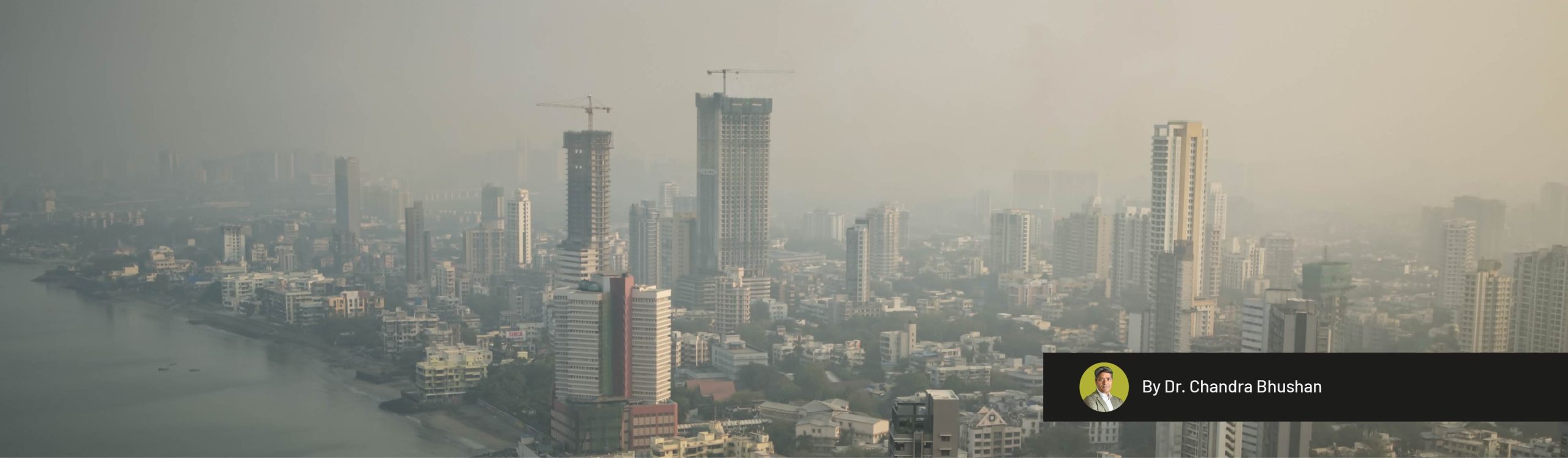
Ask any Mumbaikar, and they will describe the haze that now regularly covers the city’s skyline. A grey blanket that was uncommon two decades ago has become a familiar sight. This is not merely a perception; ground-based monitoring stations and satellite data confirm the deterioration.
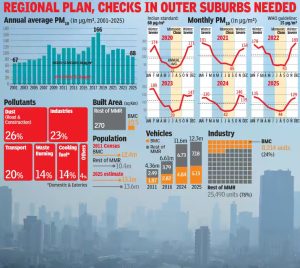
Until 2006, Mumbai’s annual average PM10 concentration remained around 60–80 µg/m³, relatively low by Indian standards. However, pollution levels began rising after 2006 and reached 166 µg/m³ in 2018. Although official figures indicate a decline since then, Mumbai’s PM10 concentration was still 88 µg/m³ in 2025, approximately 1.5 times the national standard.
Annual averages, however, do not reveal the full extent of the problem. Mumbai experiences seasonal variations in air pollution. Air quality is comparatively better between June and September because monsoon rains clear the atmosphere, while pollution becomes high to severe between October and March.
During peak pollution months, PM10 concentrations can reach three to four times the national standard. The national standard itself is relatively lenient. During winter, Mumbai’s air pollution can be 10–15 times higher than the level considered safe by the World Health Organization (WHO).
Why has a city that once took pride in its clean air and mocked Delhi for its smog deteriorated so rapidly?
An airshed, not a city
Mumbai’s air pollution is influenced by its wider airshed, which includes at least the Mumbai Metropolitan Region (MMR) and surrounding industrial areas.
The region is geographically surrounded by the Arabian Sea in the west and the Western Ghats in the east. During winter, cold and humid conditions, combined with the Western Ghats acting as a partial barrier, restrict the movement of polluted air and trap pollution within this basin.
This airshed covers approximately 7,000 sq km, while the Brihanmumbai Municipal Corporation (BMC) governs only 6% of this area.
Over the last two decades, Mumbai has expanded, but the growth across the rest of MMR has been even more significant.
Population: Since 2011, MMR has gained at least 3.9 million residents, of whom 3.2 million settled outside BMC limits. While Mumbai had a larger population within its municipal boundaries in 2011, this situation had reversed by 2025.
Built-up area: Since 2017, BMC has added approximately 10.5 sq km of roads, bridges, buildings and other developed infrastructure. In comparison, the remaining MMR has added around 270 sq km. Over eight years, development outside Mumbai covered an area comparable to Nashik Municipality.
Vehicles: The number of registered vehicles in MMR has almost tripled since 2011, increasing from 4.36 million to 12.31 million. Six out of every ten vehicles are now registered outside BMC limits.
Industry: Of approximately 33,700 industrial units monitored by the Maharashtra Pollution Control Board (MPCB) across MMR, only 25% are located within Mumbai. The remaining 75% operate outside the city.
In other words, substantial urbanisation, motorisation and industrialisation have taken place largely beyond BMC’s jurisdiction. This is a major contributor to the rise in pollution.
Yet, every winter, the focus of pollution-control action remains primarily on BMC. Mumbai’s air cannot be cleaned without addressing pollution across the entire MMR.
What pollutes Mumbai
There is currently no comprehensive pollution inventory for MMR.
However, BMC’s latest pollution inventory, which can broadly be applied to MMR, identifies the following major contributors to PM10 pollution:
- Road and construction dust: 26%
- Industries: 23%
- Transportation: 20%
- Waste burning: 14%
- Cooking fuels used in homes and eateries: 14%
Together, these sources contribute approximately 96% of the PM10 pollution load.
What MMR must do
Think regional
MMR requires a comprehensive regional clean-air plan and a dedicated regional air-quality authority to coordinate efforts among municipalities, government agencies and other authorities.
Unlike Delhi, where regional pollution-control decisions require coordination among five states, the entire MMR region falls within Maharashtra. This makes coordinated action more achievable.
Develop implementable plans
The existing clean-air plans of Mumbai, Navi Mumbai, Thane, Vasai-Virar, Ulhasnagar and Badlapur have several shortcomings.
Their proposed actions and responsibilities are often unclear, measurable targets are missing, and implementation timelines are frequently unrealistic.
A regional clean-air plan must establish clearly defined responsibilities, measurable targets, dedicated budgets and practical deadlines.
Don’t copy Delhi
Mumbai should avoid simply adopting Delhi’s most visible pollution-control measures, including the odd-even vehicle scheme, cloud seeding and restrictions under the Graded Response Action Plan (GRAP).
Such reactive interventions can adversely affect poorer communities and the environment without delivering lasting improvements in air quality.
Put teeth into enforcement
MMR has approximately 19,000 polluting industrial units, responsible for nearly one-third of the region’s pollution.
Two major changes are necessary: industries must transition towards cleaner fuels such as gas and electricity, and online pollution monitoring must become more effective.
For instance, hundreds of small industrial boilers across the region consume approximately two million tonnes of coal annually. Their emissions can only be reduced by switching to cleaner energy sources and establishing shared boiler facilities.
Enforcement also needs to become stronger. Although many industries have installed Continuous Emissions Monitoring Systems (CEMS), these systems are often poorly operated.
MPCB must independently verify the quality of CEMS data, use the information for regulatory compliance and take strict action against industries that violate pollution standards.
Build without dust storms
More than 10,000 construction sites operate across MMR. Controlling construction dust simply by sending inspectors to individual sites is not sufficient.
Dust prevention must be incorporated into project planning and design through formal dust-management plans approved by the relevant authorities.
These plans should be supported by online monitoring systems and independent third-party audits to ensure compliance.
Public transport and EVs
Nearly 65% of all journeys across MMR are already undertaken using public transport, making it the highest share among Indian regions.
Despite this, the number of registered vehicles has almost tripled since 2011.
MMR has two important opportunities: further increasing the share of public transport and transitioning the remaining vehicles towards electric mobility.
The region could take a leading role by prohibiting new registrations of petrol and diesel vehicles from 2031.
End waste burning
Although waste management has improved, the burning of municipal waste and plastic remains common in and around Deonar, Dharavi and other areas with high concentrations of informal settlements.
Such burning is particularly associated with waste recycling activities.
There must be zero tolerance for open waste burning.
Control fires
Forest and agricultural fires are becoming increasingly common across MMR.
Satellite-based fire detections increased from 5,716 in 2022 to 7,810 in 2025.
The government must introduce and effectively implement a comprehensive fire-control plan.
Clean cooking fuel
Approximately 45% of MMR’s population lives in slums and rural settlements, where solid fuels continue to be used alongside LPG.
Bakeries and eateries also rely on wood and coal for cooking.
Transitioning to LPG and electric cooking is both practical and achievable with appropriate government support schemes.
Green the region
Simply increasing road sweeping activities will not resolve the region’s dust pollution problem.
MMR needs a comprehensive greening programme that includes planting grass along suitable road edges, developing greenery on open land, expanding tree cover and increasing vegetation across the region.
Beijing’s “One Million Acres” afforestation initiative provides an example of how large-scale plantation programmes can help control dust pollution.
Monitor with purpose
Approximately 70% of MMR’s continuous air-quality monitoring stations are concentrated in Mumbai and Navi Mumbai, leaving large parts of the region without adequate monitoring coverage.
MMR needs a comprehensive monitoring network capable of identifying pollution hotspots, determining emission sources and guiding targeted interventions.
This should include:
- Evenly distributed continuous air-quality monitoring stations.
- A dense network of low-cost air-quality sensors.
- Satellite-based pollution monitoring.
Combining information from these different monitoring systems will help authorities identify pollution sources and implement targeted measures in real time.
Implementing these measures can reduce Mumbai’s pollution by more than half within five years.