Published in
 Nov 10, 2026
 4 min read
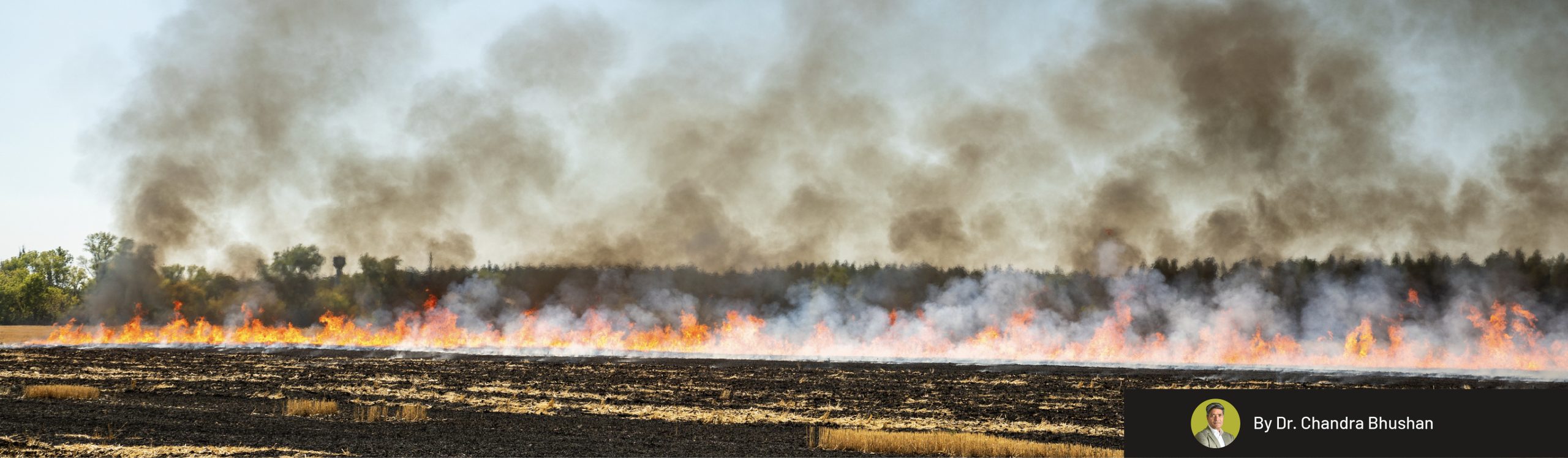
Every year, the debate resumes: Is stubble burning responsible for the poisonous air that engulfs Delhi-NCR from late October, or is the city simply choking on pollution from its own vehicles and industry? It is time to settle this debate once and for all.
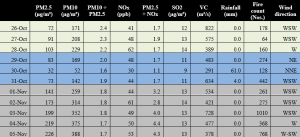
To understand what is polluting Delhi, I have analysed meteorological data from IMD stations, air pollution data from all 59 continuous monitoring stations, and stubble-burning data from both polar-orbiting and geostationary satellites. The analysis covers 26 October to 5 November 2026, a period that divides neatly into three distinct phases: before rains (26–28 Oct), influenced by rains (29–31 Oct), and post-rain (1–5 Nov).
Delhi’s pollution began rising on 26 October, when the PM2.5 concentration was 72 µg/m³. By 5 November, it had reached 226 µg/m³—a threefold increase in just 10 days. There was one break: during 29-31 October, rain and winds cleaned the air, bringing PM2.5 down to 32 µg/m³ on 30 October.
The usual explanation for this rapid rise in pollution is the weather. In winter, air near the ground becomes colder than the air a few hundred metres above it. This creates a temperature inversion, where warm air sits over cold air like a lid on a pot, trapping pollution close to the ground. Add calm winds, and the pot gets no stirring either. Scientists combine the height of this lid (mixing height) and wind speed to calculate Ventilation Coefficient (VC). It tells us how effectively the atmosphere can disperse pollution.
So, did Delhi’s VC start declining from 26 October, when pollution began rising? No. It remained between 300-800 m²/s throughout the period. A VC below 2,000 m²/s indicates poor conditions for dispersing pollution. Delhi was well below this threshold. Temperature inversion and calm winds, therefore, cannot account for the threefold rise in PM2.5.
Could Delhi’s own emissions have tripled instead? There is no evidence of that either. In fact, from 1 November, non-BS-VI vehicles registered outside Delhi were barred from entering the city, which should have reduced traffic emissions. Yet nitrogen oxides (NOx), pollutants closely associated with vehicle exhaust, showed no major change.
Between 26 October and 5 November, NOx rose marginally, from 41 to 53 ppb, while PM2.5 tripled. The ratio of PM2.5 to NOx, therefore, more than doubled, from 1.7 to 4.3. In simple terms, fine particle pollution increased far more sharply than pollution associated with vehicle exhaust. This suggests that vehicles were not the main reason for the sudden rise in PM2.5.
Could industries have caused the surge? The data suggest otherwise. Sulphur dioxide, associated with burning fuels in industries and other sources, remained almost unchanged at 11–13 µg/m³ throughout the period.
What about dust from roads and construction? This, too, cannot explain the surge. The ratio of PM10 to PM2.5 actually declined, meaning that larger particles, typically associated with dust, made up a smaller share of the total particulate pollution. The evidence, therefore, points to a clear conclusion: Delhi’s own sources cannot lead to threefold increase in PM2.5.
Then what explains the surge? Two things changed around 31 October. First, Delhi’s winds shifted from northeasterly to west and west-southwesterly, bringing air from Punjab, Haryana and Rajasthan. Second, stubble burning increased sharply in these states.
The number of farm fires detected by satellites increased more than fivefold, from 178 on 26 October to 1,010 on 3 November. But even these numbers greatly underestimate the actual burning. Many farmers in Punjab and Haryana deliberately light fires after 3 pm, avoiding detection by satellites that pass overhead around 1:30 pm. Smoke from thousands of these fires rides the high-altitude winds, spreading across the entire Indo-Gangetic Plain.
Nothing other than stubble burning, therefore, can explain threefold increase in PM2.5. Without the incoming smoke, I estimate that Delhi’s average PM2.5 levels during 1–5 November would have been around 90–110 µg/m³, rather than the recorded levels of 141-226 µg/m³. So, roughly half of Delhi’s PM2.5 pollution came be attributed to stubble burning.
We can continue arguing about vehicles and industries, and pollution from these sources must certainly be reduced throughout the year. But if we want to substantially improve Delhi’s air quality from late October to early December, eliminating stubble burning must be a priority.
The anatomy of pollution