
 Published in
  Sep 16, 2026
  5 min read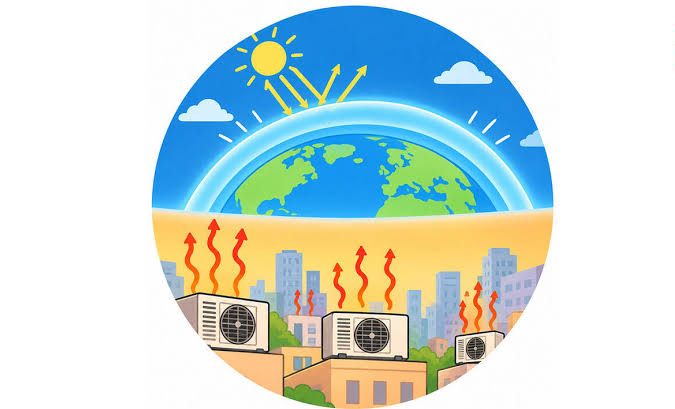
The Montreal Protocol has delivered, but it must transform to deal with new threats to the planet.
Four decades ago, the world did something remarkable. It discovered that refrigerants once celebrated as technological miracles were destroying the ozone layer, and it responded by negotiating a global treaty to phase them out. Crucially, the agreement recognised differentiated responsibilities: developed countries committed to funding the transition in developing countries.
The result has been extraordinary. The universally ratified Montreal Protocol has eliminated about 99% of controlled ozone-depleting substances (ODS). The ozone layer is healing and is expected to return to 1980 levels by around 2040 across most of the world.
Its climate benefits have been equally significant. Because many ODS are also potent greenhouse gases (GHGs), their phase-out has already spared the planet roughly 0.5°C of warming. The Kigali Amendment to the Montreal Protocol, adopted ten years ago to phase down another family of refrigerants, hydrofluorocarbons (HFCs), could avoid another 0.3–0.5°C of warming by 2100. In other words, without the Montreal Protocol, the world could be 0.8–1°C warmer by the end of this century.
On World Ozone Day, this success deserves celebration. But the best way to honour the Montreal Protocol is not to freeze it in time. It is to ask what the treaty must become over the next 40 years.
The fact is that the Protocol now faces challenges that could undermine its hard-won gains. New threats to the ozone layer are emerging. At the same time, the refrigerants and cooling technologies being promoted are creating new risks for the environment and the climate. The Montreal Protocol must therefore be transformed to deal with these emerging realities.
New threats to ozone
The refrigerants targeted by the Montreal Protocol are declining, but other major ODS remain uncontrolled. Nitrous oxide (N₂O), released mainly from nitrogen fertilisers and industrial processes, is now the single most important ODS emitted by human activities. Yet it is not controlled by the Protocol.
There is also the problem of ozone-depleting chemicals used as feedstocks for manufacturing other chemicals. These are exempt because they are assumed to be consumed during production. But a 2026 study found that actual ODS emissions from feedstocks are seven times higher than previously assumed. Continued emissions at these levels could delay ozone-layer recovery by close to a decade.
Then there is geoengineering. Proposals to inject sulphur particles into the stratosphere to reflect sunlight and cool the planet could alter stratospheric chemistry and damage ozone. The Montreal Protocol’s scientific bodies have already recognised this risk, but countries have not yet chosen to act.
To deal with these threats, the Protocol must become a treaty that governs any activity capable of damaging the ozone layer, whether or not the offending substance or activity is on its control list.
Threats to the environment
The Protocol has run on a chemical treadmill: replacing one refrigerant because of an environmental problem, only to discover another problem with its replacement.
First came chlorofluorocarbons (CFCs), which were phased out because they destroyed the ozone layer. They were replaced by hydrochlorofluorocarbons (HCFCs), which still damaged ozone, but less so.
HCFCs were therefore replaced by HFCs, which do not damage the ozone layer but are hundreds to thousands of times more potent than carbon dioxide in warming the planet. Now HFCs are being replaced by hydrofluoroolefins (HFOs), which damage neither ozone nor the climate.
But another problem is emerging. HFOs break down quickly into trifluoroacetic acid (TFA), one of the so-called “forever chemicals”, which no water treatment plant can remove. TFA is now in rainwater, rivers, groundwater and drinking water.
It is time to break this treadmill. The long-term direction should be towards technologies that avoid refrigerants wherever possible, and towards natural refrigerants, such as ammonia, carbon dioxide, propane and other hydrocarbons, that are safe across their full environmental life cycle.
Threats to the climate
The Montreal Protocol has focused on the gas that goes inside the cooling appliance. But the appliance itself matters just as much. Conventional air conditioners (ACs) and refrigerators are built on vapour-compression technology, which consumes large amounts of electricity. Over the lifetime of an AC, roughly 70% of its climate impact can come from the electricity it consumes, while only about 20–25% comes from the refrigerant.
With extreme heat contributing to half a million deaths every year globally, cooling is no longer a luxury but a matter of survival. That is why AC sales are soaring worldwide.
The International Energy Agency projects that the world’s stock of ACs will more than triple by 2050 and that cooling electricity demand will triple as well, putting electricity grids under severe strain. UNEP estimates that cooling-related GHG emissions could rise from 4.1 billion tonnes in 2022 to 7.2 billion tonnes by 2050. These numbers tell us that we cannot solve the climate challenge simply by putting a better gas into billions of highly energy-intensive machines.
We need low-energy solutions that already exist but are not being promoted. Buildings can be designed for passive cooling, and low-energy technologies such as evaporative and hybrid cooling can meet a significant share of demand. Similarly, centralised cooling can serve apartment and commercial complexes far more efficiently than millions of individual ACs.
This is where the Montreal Protocol must evolve: from a refrigerant-transition treaty into a sustainable-cooling treaty.
That does not mean abandoning its core mandate. It means extending the principles that made it successful: follow the science, help developing countries finance the transition, and strengthen the regime as knowledge evolves.
The Montreal Protocol saved the ozone layer because it was willing to change as the science changed. Its next test is whether it can change again. The bottom-line is that the ozone story should not end with a repaired sky, but polluted water and an overheated planet.