

 Published in
  Aug 24, 2026
  6 min read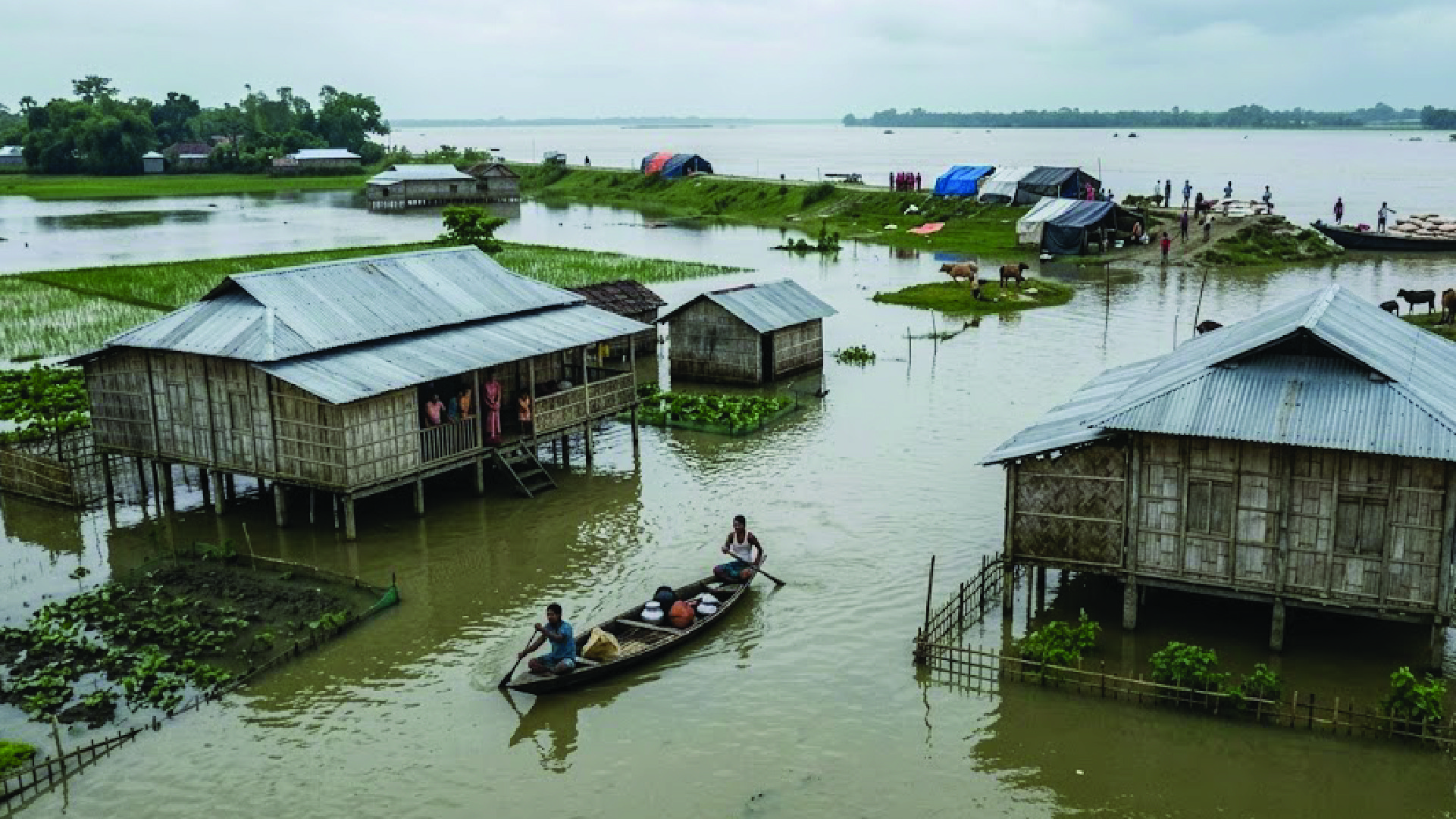
Global warming is changing the character of Assam’s floods. The state must prepare for it.
Assam received less rain than normal this July, yet parts of the state suffered their worst flooding in six decades. This paradox should worry us.
By the last week of July, Assam had received nearly a third less rainfall than normal, placing the monsoon in the “deficient” category. Yet Sivasagar, Charaideo, Jorhat and Golaghat -districts where most families had never experienced severe flooding in living memory -went under water.
The water also came with frightening speed. In parts of Sivasagar, families had at most an hour to pick up what they could carry before the flood entered their homes.
The flood was not caused by extraordinary rainfall over Sivasagar or Jorhat but was triggered by extreme rainfall in neighbouring Nagaland. On 19 July, parts of Nagaland received exceptionally heavy rain; in Mokokchung, rainfall was close to 500% above normal. Water rushed down the hills, entered the southern tributaries of the Brahmaputra and reached the plains of Assam within hours.
The new normal
It is tempting to describe this as a once-in-sixty-years event and move on. The evidence suggests otherwise.
Between 1980 and 2000, an average of 32,000 km² of Assam was at risk of flooding. Our assessment, based on multiple models, suggests that by mid-century, the area at risk could expand to 50,000–60,000 km². That is well over half of Assam.
Floods will also become deeper, and this matters more than it may appear. Assam has always lived with shallow flooding, and communities know how to cope with it. Deep flooding is different. It does not merely disrupt life; it destroys homes, crops, infrastructure and livelihoods.
Our analysis shows that the share of Assam exposed to deep flooding could rise from about 36% historically to between 50% and 60% in the coming decades. That is precisely what Upper Assam experienced in July: not the familiar, gradual rise of water, but a sudden and violent surge driven by extreme rainfall upstream.
Our assessment also reveals something even more uncomfortable. Over the next two decades, it makes surprisingly little difference to Assam’s flood risk whether the world cuts emissions quickly or slowly. Flood projections until around 2050 remain broadly similar across different IPCC emissions scenarios. The global warming that has already occurred is shaping Assam’s flood risk over the next quarter-century.
This does not mean that cutting greenhouse-gas emissions is unimportant. On the contrary, emissions reductions today will determine how severe climate impacts become after mid-century. But Assam’s immediate challenge is to live with increasing floods while drastically reducing the loss of lives, livelihoods and infrastructure.
Investing in resilience
This may sound daunting, but there are practical ways to adapt and build resilience. Consider what Assam has already lost. Between 2015 and 2024, floods and landslides caused officially recorded damage worth ₹27,925 crore. This figure mainly captures what can be counted – roads, bridges, embankments and other infrastructure. It does not fully capture the private economic and social costs, which are likely to be considerably higher.
Now consider the opportunity. Our modelling shows that if Assam plans according to climate risk, builds infrastructure to withstand floods and reduces the exposure of its poorest households, expected future losses could be reduced by nearly 70%, even as flood risk increases. Every rupee spent on flood resilience could save an estimated four to ten rupees in avoided damage.
The next ten to fifteen years therefore offer Assam a critical window to invest in resilience. Five things need to happen – and Assam already knows how to do all of them.
First, decide where people can build. Maps identifying areas exposed to deep flooding and erosion must be officially notified and made binding on town planning authorities, panchayats, public works departments and municipal bodies. New construction must be restricted in the highest-risk zones. Many such maps already exist. What is missing is a rule requiring everyone to follow them.
Second, change how Assam builds homes. The state needs a clear building code designed for a wetter, more flood-prone and hotter climate: raised plinths, heat-resistant roofs and materials that can withstand prolonged exposure to water. Compliance must be enforced through a robust building-permission system.
Assam does not need to look far for ideas on constructing flood-resilient houses. The traditional saang ghar is a powerful example of living with floods. Modern materials and engineering can adapt these traditional principles to create homes that are resilient to changing climatic conditions.
Third, build resilient infrastructure. Roads, power lines, airports, schools, hospitals and other critical infrastructure must be designed for future climate conditions rather than historical averages. Nearly half of Assam’s major road network passes through highly flood-prone areas. Every new road, substation or health centre should have to answer one simple question before it is sanctioned: what happens to this when the water rises?
Fourth, warn people earlier and provide relief faster. Warnings must reach people in local languages through radio, television, mobile phones and automated calls. Every panchayat and urban ward should have trained volunteer groups capable of supporting evacuation, rescue and relief. Systems must also ensure that compensation reaches affected families quickly so that they can rebuild their lives without falling into debt.
Fifth, and most importantly, work with neighbouring states. Assam cannot manage its floods alone because much of the water that floods the state originates outside its borders. The state needs a permanent working arrangement with neighbouring states. Rainfall and river-level data should be shared in real time, supported by a basin-wide warning system and coordinated management of upstream catchments.
This must also include an honest conversation about forest loss, hill cutting, roads and construction upstream. A rain gauge in the Nagaland hills that gives Sivasagar three additional hours of warning could save more lives than several kilometres of embankment. Such cooperation requires an institution with adequate funds, technical capacity and authority.
Beyond these five measures lies perhaps the cheapest flood protection Assam already possesses. Its wetlands, beels and catchment forests absorb, store and slow down water naturally. Restoring them can cost a fraction of providing equivalent protection through concrete infrastructure, while delivering ecological benefits that engineered structures cannot.
July has shown Assam that the character of flooding is changing. Places that believed they were safe are no longer safe, and floods that once developed slowly can now arrive within hours. In a warming climate, Assam can face devastating floods even in a deficient monsoon year.
The question is whether the floods of Sivasagar, Golaghat, Jorhat and Charaideo will be remembered merely as another tragedy – or recognised as a clear and present danger.